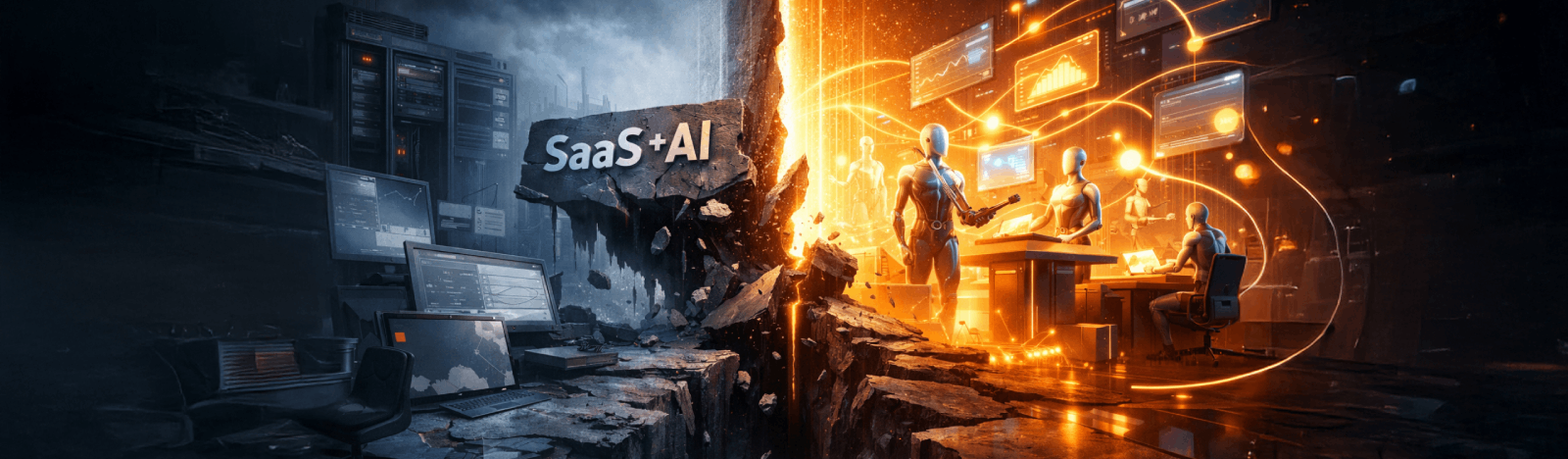
If 2025 was the year every product slapped “AI” into its tagline, 2026 is when we find out who actually meant it. At Diffco, we sit inside a lot of real products: SaaS platforms, AI copilots, mobile apps, internal tools and MVPs that turn into real businesses. We see what’s working, what’s hype, and what quietly dies on renewal day. Here’s how we think 2026 actually plays out. No sci‑fi AGI fantasies—just very real shifts that will change how software is built, sold, and used.
1. AI and SaaS become indistinguishable
In 2026, “AI product” stops being a separate category. It’s just… software.
Every serious SaaS will have:
- AI at the core of workflows, not just a chatbot in the corner
- Models fine-tuned on the customer’s own data, not generic “sprinkle some GPT on it” features
- Pricing and packaging that assume AI is doing a big chunk of the work
The same way no one brags about having a “cloud-based app” anymore, saying “we’re an AI-powered SaaS” will sound like saying “our website works on the internet.”
If your product isn’t AI-native, it won’t compete on speed, quality, or experience. That’s the bar.
2. AI agentic UI: you approve what’s already done
2023–2024: Copilots that suggest things.
2025: Copilots that help you do things.
2026: Agents that just go and do the things.
We expect a huge shift in product UX:
Instead of tools waiting for your input, agents will:
- Watch for triggers (new leads, new tickets, new orders, new alerts)
- Launch workflows automatically (draft the email, update the CRM, create the report, file the ticket)
- Present you a simple interface: “Here’s what I already did. Approve, edit, or undo.”
You’re no longer “using software.” You’re managing a small fleet of AI workers.
The UX pattern becomes:
Don’t ask me to do the task.
Show me what you’ve already done.
Products that nail this “approve-first” agentic UI will feel magical. Products that still make users click through 12 screens to get a simple outcome will feel ancient.
3. Tiny teams, huge output: AI-native companies disrupt the old guard
We’re going to see a lot more of this pattern:
- 8–10 people
- AI agents doing the work of what used to be 80–100 people
- Shipping faster than large, well-funded incumbents
Why? Because AI-native startups:
- Design processes assuming agents do the grunt work
- Don’t carry legacy systems or politics
- Don’t need layers of middle management just to move pixels around
Meanwhile, large companies:
- Glue AI on top of existing workflows
- Keep the same org chart and processes
- Add “AI initiatives” instead of redesigning how work happen
In 2026, “small team, big company impact” won’t be a slogan. It will be a normal operating model.
4. AGI is still not here (and that’s actually fine)
Despite all the “exponential curve” slides, we don’t think 2026 is the year of AGI. Not even close.
What we’ll actually see:
- Much better specialized models
- More robust tool-using agents (that can call APIs, operate UIs, reason across steps)
- Better governance, monitoring, and guardrails
- A lot fewer “wow, it wrote a poem” demos and a lot more “it quietly saved us $500k/year” stories
The anxiety about AGI will stay loud on social media. But inside real companies, the conversation will be far more practical:
- How do we automate this process safely?
- Where are the real ROI opportunities?
- How can we seamlessly integrate AI into our stack without causing disruptions, or is it time to rethink our existing approach?
We won’t have AGI. We will have a lot more AI that does narrow, boring, profitable work extremely well. That’s plenty.
5. An AI-native version of every legacy app appears
For almost every big, established SaaS category, we expect to see a serious AI-native challenger by the end of 2026:
- AI-native CRM
- AI-native project management
- AI-native ERP
- AI-native support tools
- AI-native analytics
These aren’t just “the same thing, but with a chatbot.” They’ll rethink the core assumptions:
- Less data entry, more auto-population
- Less “create object,” more “confirm I created this for you”
- Less reporting, more “here’s what you should do next”
Meanwhile, legacy apps will keep… slowly adding AI tabs and beta features. The classic innovator’s dilemma: they can’t move fast without risking what already works.
This creates a huge window for new players who build for AI from day one.
6. Zombie SaaS finally dies as renewals come up
Every company has that list of:
- Tools nobody remembers buying
- Products nobody logs into
- “We might need this someday” subscriptions
In 2026, a lot of those tools get replaced overnight by AI-native alternatives that are:
- Cheaper (or at least bundle more value)
- Less manual
- Easier to integrate
- Actually used
We expect to see:
- More zombie SaaS in the wild as people realize they’re paying for tools AI now does better
- Then a sharp drop as finance, IT, and operators start cutting anything that can’t justify itself against AI alternatives.
For product teams, this means: if your app is “nice to have” and not clearly AI-leveraged… watch your renewal rates.
7. Incumbents keep gluing AI on top—and keep missing the point
We’re already seeing this, and 2026 will double down:
- Add “AI Assistant” button on top of a 15-year-old UX
- Call it a day
- Update homepage: “Now with AI!”
The problem? Users can feel when AI is bolted on instead of built-in. It looks like:
- Chat windows that can’t actually do anything inside the product
- “Smart” suggestions that still require 10 manual steps
- Inconsistent behavior across different parts of the app
True AI-native products feel different:
- The default path is the automated path
- Manual workflows exist, but as a fallback—not the main event
- The product feels like a teammate, not a form with a marketing layer
In 2026, we’ll see a real split:
- Companies that use AI as decoration
- Companies that use AI as infrastructure
Users will know the difference instantly.
8. The first 10‑person, $100M ARR startup (or 10‑person $1B company)
We’re betting that by the end of 2026, we’ll see at least one of these:
- A 10-person company hitting $100M ARR
- Or a 10-person team building a product valued at $1B+
Not through marketing tricks or vaporware, but because:
- AI agents handle support, onboarding, and operations
- Automated systems generate content, proposals, reports, even GTM experiments
- The product itself is so leveraged that each user unlocks outsized value
Will this be common? No. Will it be possible for the first time in a credible way? Yes.
The idea of a “lean startup” is about to be redefined.
So… what should you actually do in 2026?
If you’re building or running a product, here’s how to think about the year ahead:
- Stop asking “Where can we add AI?” and start asking “Where can AI own this workflow end-to-end?”
- Design for agents, not users. Move from “click here, fill this” to “the system already did it, you just approve.”
- Audit your stack for zombies. If a tool can’t justify itself against AI-native competition, its days are numbered.
- Rethink team structure. Assume AI agents can handle a meaningful part of execution. What does your ideal team look like then?
- Build AI-native from the start. Gluing AI on top of a legacy UX is the most expensive and least effective path.
How Diffco fits into this future
This is the world we’re building for every day—AI-native SaaS, mobile apps, internal tools, and platforms that don’t just “have AI,” they run on it.
We help companies:
- Go from idea to AI-native product
- Modernize legacy apps with real agentic workflows (not just a chatbot)
- Build compact, high-leverage teams backed by strong engineering
If you’re thinking, “We should be on the right side of these predictions,” let’s talk.
 Let’s build something AI-native together.