If you're hiring an AI build partner this year, the market is harder to navigate than it has ever been. A few years ago, "AI agency" meant maybe a hundred boutiques globally with real production chops. Today, every web shop, every offshore staff-augmentation house, and every two-person LinkedIn duo has an "AI" page. The cost of putting up a confident-sounding capability deck has collapsed. The cost of figuring out which of them can actually ship a product that survives contact with real users hasn't.
This guide is for the buyer side. CEOs, CTOs, founders, heads of product, and anyone signing a contract for an AI built in 2026. We've watched a lot of these go right, and a lot of them go wrong. Here's the framework we'd use if we were buying.
Start with the right question
The wrong question to lead with is "Have you built something like this before?" — every reasonable agency will say yes, and the answer doesn't predict outcomes anyway. AI builds rarely fail because the team has never seen the domain. They fail because the team has never seen production.
The right question is: "Walk me through your last AI project from kickoff through six months after launch."
Listen for what shows up unprompted. A team that's actually shipped will talk about evaluation harnesses, prompt versioning, cost dashboards, the incident where the model started returning malformed JSON, the migration off one model onto another, and the moment they had to explain to a customer why the agent gave a wrong answer. A team that hasn't will talk about the demo, the launch event, and the press release.
The post-launch six months are where the truth lives. Anyone can ship a demo. Few can keep an AI product running for half a year without the wheels coming off.
The four capabilities that actually matter
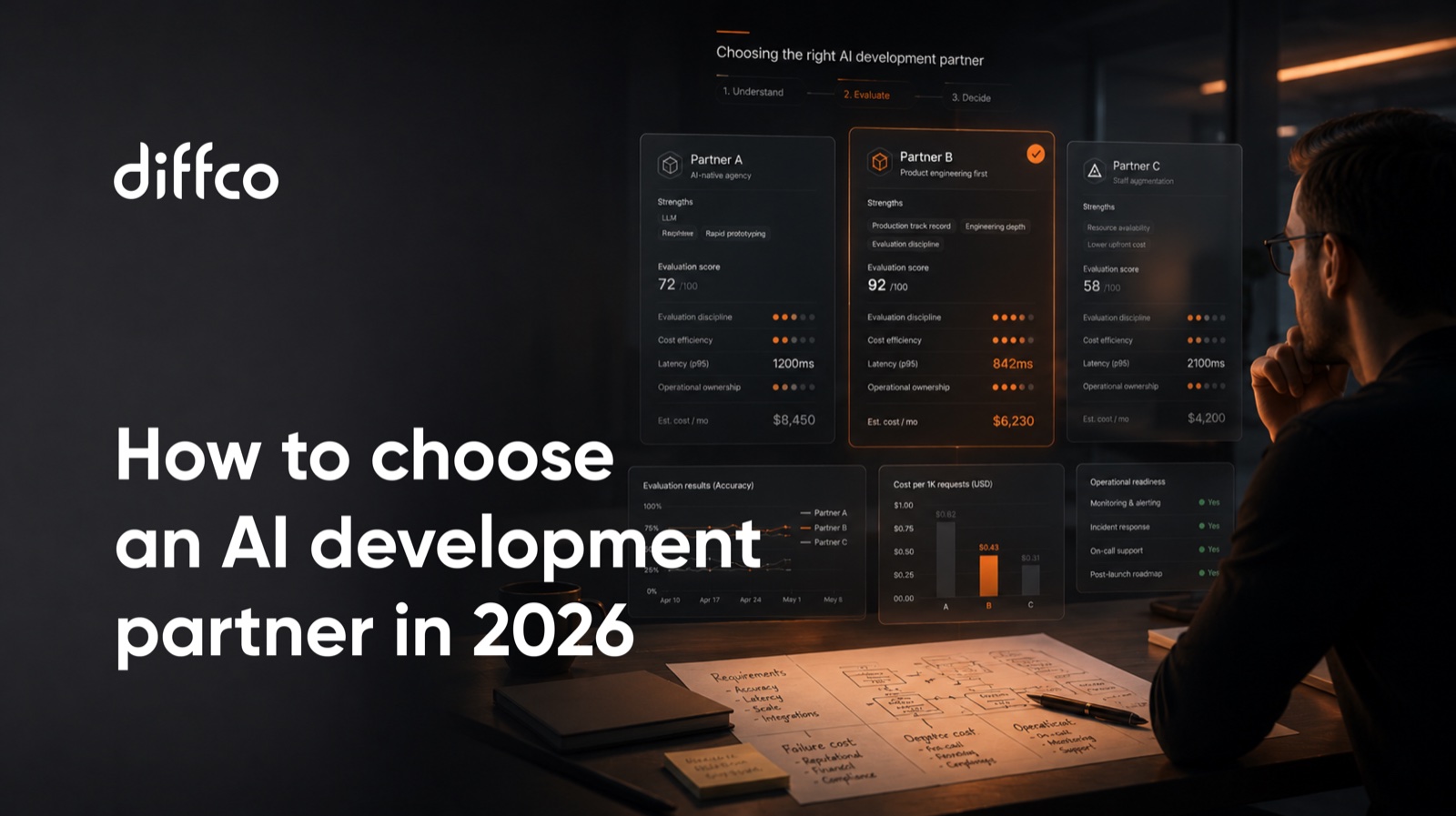
Cut through the marketing, and there are really four capabilities that determine whether a partner will deliver. Score each from 1 to 5 — most agencies will be strong in one, mediocre in two, and absent in the fourth.
1. Product engineering, not just AI engineering. Most AI failures are software engineering failures. The model call works; the queue backs up, the schema breaks, the retry logic loops, the auth token expires. A real partner has senior product engineers who happen to know AI — not AI specialists who outsource the boring 80%. Ask: Who on your team has shipped a SaaS product to a million users without AI? If the answer is nobody, the AI part is the least of your problems.
2. Evaluation discipline. The single best predictor of AI build quality. If a partner can't show you an eval set from a recent project, demonstrate how they score model changes, and explain the failure modes their evals are designed to catch — they're guessing, and you'll be guessing with them. "We do qualitative review with the customer" is a polite way of saying "we have no eval pipeline."
3. Cost and latency literacy. Ask for the cost-per-request and p95 latency on three of their recent builds. A serious team has these numbers at their fingertips. A weak team will quote build cost in dollars and avoid the per-request question. Build cost is a one-time number; per-request cost is what you actually live with for years.
4. Operational ownership. Who's on call when the agent starts hallucinating in production? Modern AI products require a stable, observable production runtime. Make sure someone is responsible for it after the launch dinner.
Red flags that should kill a deal
Some of these are obvious, some are easy to miss when you're optimistic about a deck.
- The proposal opens with model selection. A team that wants to talk about Claude vs. GPT vs. Llama before they've understood your failure cost is selling commodity work. Model choice should follow architecture, not lead it.
- No mention of an evaluation set. Every credible AI proposal in 2026 names an eval set as a Week 1 deliverable. Its absence is the loudest red flag in the building.
- The architecture diagram has a multi-agent loop on slide one. This is fashion-driven engineering. Multi-agent has its place — almost always farther down the architecture decision tree than people draw it. A team reaching for it on the cover page is reaching for complexity, not for results.
- Pricing is a single number, not a structure. "$120k for the build" without a breakdown of discovery, eval set, runtime instrumentation, and post-launch support is a black box. You will discover the missing line items during the project, at your expense.
- References are demos, not customers. A team that can show you a polished demo but can't put you on a 15-minute call with a real customer running the thing in production is hiding something. Always insist on the customer call.
- They've never said "no" to you in the sales process. Partners worth hiring will push back on at least one of your assumptions — scope, timeline, model choice, the very idea that AI is the right solution. Yes-people in sales are yes-people in delivery.
What "good" looks like in a first conversation
When we're buying — for ourselves or advising clients — a first call with a real partner has a specific texture. They ask more than they tell. They steer toward your failure cost and your operational reality, not your AI ambition. They volunteer their last project's eval scores and per-request costs without being asked. They tell you which of your assumptions they think is wrong. They quote a phased plan that makes them earn the second phase. They name the engineer who'd lead the build, and that engineer can sketch an architecture on a whiteboard in five minutes.
Most importantly, they make you feel like the project is harder than you thought, not easier. AI builds that ship are the ones where everyone went in with their eyes open. AI builds that fail are the ones where the partner promised a clean line from prototype to production and the buyer wanted to believe it.
The bigger picture
The thing that's changed in 2026 is that AI capability is no longer the differentiator. Every competent shop has access to the same models, the same SDKs, the same orchestration frameworks. What separates partners now is engineering discipline — eval rigor, observability, cost control, the patient unsexy work of making AI behave the same way at request 100,000 that it did at request 1.
If you're choosing a partner this year, optimize for that discipline. The model fashion of the moment will be obsolete in eighteen months. The discipline outlasts the model.
Evaluating an AI build partner? Diffco is happy to be on your shortlist — and equally happy to give you a candid second opinion on someone else's proposal. Book a 30-minute call and bring us a deck to tear apart.