
How Diffco Builds Software with AI
How Diffco Builds Software with Our Own AI SDLC Methodology
Custom software development with AI, built to reach production fast,
hit its goals, and stay right as your business evolves.
Diffco’s AI SDLC methodology is a way of building custom software in which senior engineers decide what to build, 100+ AI agents build it around the clock on our own delivery platform, and a living plan with automatic checks keeps every decision traceable.
AI has made writing code fast
It hasn’t answered the questions you still have to ask yourself:
 Are we building the right thing?
 Is it built on the right foundation, one that will hold up over the long term?
 Will it keep up as the business changes?
 How do we verify the result is correct without reading every line of code?
Our answer rests on three things
- Senior engineers decide what to build and how.
They are backed by 18+ years of shipping software across healthcare, finance, and other regulated industries.

- 100+ AI agents per engineer do the building, around the clock.
It is agentic software development, with our engineers, architects, and product managers directing.

- A living plan with automatic checks keeps every agent inside the lines.
Every decision that matters is made by a person and stays on record.
Code is the cheap part now. Knowing what to build first, which foundation will hold at ten times the users, and what not to build at all: that’s where projects are won. We bring that judgment into the room before any agent writes a line. We arrive with a first draft of your plan, not a blank questionnaire, and we’ll tell you when AI is the wrong tool for the job.

What this means for you

You see your product in weeks, not months
Discovery takes days. Within the first weeks you get a clickable walkthrough of a whole piece of your product: real screens, real content, in the order your users will meet them. Working software follows soon after.

You always know where the project stands
One page shows what’s finished, what’s waiting on your decision, and what needs a second look.

We run it as a product, not a ticket list
Discovery ends with outcomes to hit, not features to ship. When a decision is contested, agents build both versions in hours, and you and your users settle it. We bring the evidence; you make the call.

Changes cost what they should
Small ones just get made. Bigger ones come back with everything they touch, what has to be rebuilt, and what quietly needs a second look, so you decide with the full picture and never pay for a process heavier than the change itself.

The records regulated buyers need are produced along the way
Traceability, the decision log, and review history are by-products of how we build, not a documentation project at the end.
The methodology in eight points
Are we building the right thing?
- You click through your product before we build it.
Within days, a whole flow prototype (sign-up, checkout, approvals) becomes real screens you can use, not a document you read. You change your mind while it’s still cheap. Anything nobody has decided yet is marked on the screen, so it becomes a decision in week one, not a surprise in month five.
- We bring you the parts of the job you never put into words.
Before writing anything, our AI agents read everything you have: your product, your past decisions, every call recording and note. Our engineers turn what they find into the details you didn’t mention: the edge cases, the missing states, the questions nobody asked. Each one is marked as our suggestion, ranked by how much depends on it, and yours to accept, reject, or talk through with us.
Is it built on the right foundation?
- We start from what you already have.
We review your existing technology before recommending anything new, and we prefer proven tools unless something newer earns its place. The foundation that holds at ten times the users matters more than the one that’s fastest this week.
- Every architecture decision is written down with the alternatives.
Choices that are expensive to reverse are flagged before they’re made, and each design is reviewed by senior engineers looking for mistakes, over-engineering, and simpler options. A decision from month one can be re-examined in month twelve, with its context intact.
Will it keep up as your business changes?
- Everything traces back to a goal, which is what makes change fast.
Each goal lists what the software must do, each of those says how it works, and each piece of code names the part of the plan it fulfills. When a requirement changes, everything that depended on it is flagged the same day: what needs new work, what’s invalidated, and what looks untouched but needs a second look. You approve that picture, then we build. This is the difference between software that absorbs change and software that quietly breaks somewhere else.
- People make the decisions, and agents build inside them.
No agent can change a goal, a requirement, or a rule on its own; each change carries a named person and a date. Every time work is saved, a checker runs, and a change that breaks the plan doesn’t go through. And when you say no to something, the reason is kept as a constraint, so nobody proposes it again nine months later.
How do we know it’s correct without reading every line?
- Before release, a person watches it work.
For each important thing your users need to do, we write down what “working” means before the code exists, and you agree to it. At release, that thing is demonstrated live on the real product, and a person signs off against the standard you agreed. The sign-off is attached to the version that was demonstrated, so when the code underneath changes, the demonstration comes back to you rather than quietly aging.
- The whole project is a document you can read.
Finished, waiting on you, needs a second look. Under each item is the decision that produced it and the evidence behind it, in plain files that live beside your code and belong to you. Your auditors can read it, your internal developers can read it, and so can you.
The loop
- You say what you want
- We show what it affects and what we’d build
- You approve
- Agents build inside the plan, with a check on every save
- A person watches it work and signs off
Every later change re-enters the same loop, and nothing skips a step.
That’s what keeps a fast-built product correct as it grows.

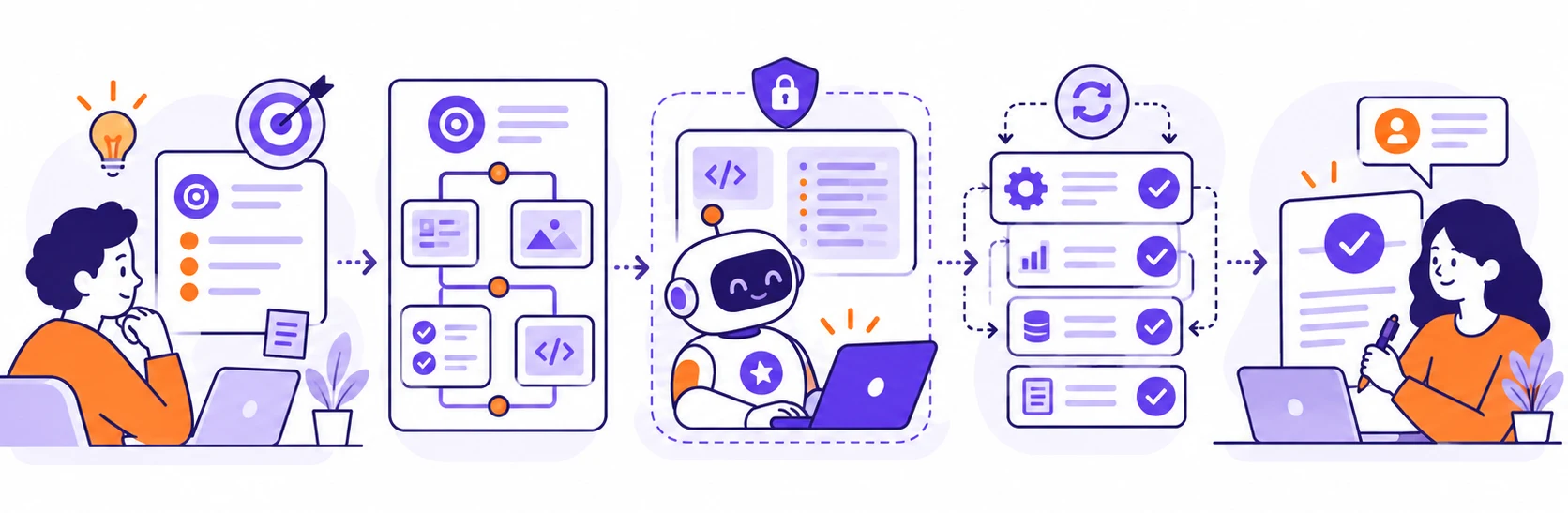
Our AI delivery platform: 100+ agents on Claude Code and Codex
Senior engineers, architects, and product managers direct the work. More than 100 AI agents do it: writing code and tests, reviewing each other’s output, and keeping the plan current, in parallel, without going home at six.
Our own AI delivery platform is the harness that makes a hundred agents governable.
Built on Claude Code and OpenAI Codex, it puts your plan, your rules, your decision log, and your compliance requirements in front of every agent before it starts, and checks everything it produces. The plan is a living specification, so this is specification-driven development with the agents doing the typing. Any team can rent a hundred agents. Ours work inside one plan instead of a hundred chat windows.
The system learns your project, product, and business goals, not just software in general.
Ask for the same thing twice and it becomes a project rule every agent follows from then on. Firm decisions are never quietly traded away; passing preferences never block progress. You shouldn’t have to repeat yourself in month four.
How a project runs
Discovery (a few days to two weeks).
We agree on the goals, the rules that must never be broken, and what the software has to do. You leave with a plan you can use with or without us, and an estimate that shows its uncertainty instead of hiding it: a range, and the open questions that make it wide.
Design and build (weeks, not quarters).
Walkthrough first, then features designed, reviewed, and built by AI agents under our senior engineers, each delivered with its tests and passing the automatic checks.
Verify and release.
Key user tasks are demonstrated live on the real product, you sign off, and we hand over the runbooks with it.
Keep improving.
Every later request goes through the same loop. Existing software, yours or someone else’s, is brought under the plan without a rewrite.


Who this is for
Diffco is an AI engineering firm in San Jose, California, building custom software with AI for healthcare, finance, and regulated industries.
Software that will outlive the team that built it.
Regulated industries, systems where mistakes are expensive, and products where the accuracy of an AI feature is the product.
Teams still figuring out what they’re building.
We mark which requirements are likely to keep moving and build those so they’re cheap to replace, so early exploration doesn’t harden into permanent structure.

Not for a throwaway prototype or a two-week experiment.
We’ll say so, and run something lighter that ships fast and works great.

Frequently Asked Questions
It goes into the plan first, not into a checklist at the end. Your requirements become rules every AI agent reads before it starts and the checker enforces on every change, including which models may see your code and what data the agents can touch. What comes out is the evidence auditors ask for: each requirement traced to its code and tests, and a dated log of who approved every change.
No. It’s how we go faster without losing control. Issues surface the moment work is saved, when they’re cheapest to fix, and the agents don’t stop when the office closes. What disappears is the rework from a requirement that changed in March and was noticed in October.
No. Your team makes decisions and reads reports. The AI agents do the day-to-day writing, and the plan is plain files that live with your code.
You do, in full, from the first week. The goals, the specifications, the decision log, and the acceptance standards are yours to keep and take anywhere, including to another team.
That’s a normal event here, not an exception. We show you what the change touches, you approve, and it gets built.
By showing it to you. Passing tests are necessary, but they’re not the same as a person watching your software do the job on the real product and signing off.
Our own AI delivery platform, running on top of leading coding agents such as Claude Code and OpenAI Codex. The plan and the checks don’t depend on any one model, so we adopt better models as they arrive without changing how your project is run.
We add the plan beside your existing code without touching it, and the checks apply to new work from day one. Older areas come under the plan as you touch them, at the pace you choose.