Repo Score
AI-Powered Performance Intelligence for the Field:
How HNS Recovery Turned Three Operational Systems and an LPR Fleet into One Live Score
Diffco designed and built RepoScore, a mobile and web performance platform that pulls repossession, GPS, and fuel data from HNS Recovery's existing systems and turns it into one clear score every field agent and manager can act on daily — and extended it with an AI layer for license plate intelligence and business analytics.
- AI & Analytics
- LPR Intelligence
- Mobile App
- Web Portal
- Data Integration
- B2B Internal Tool
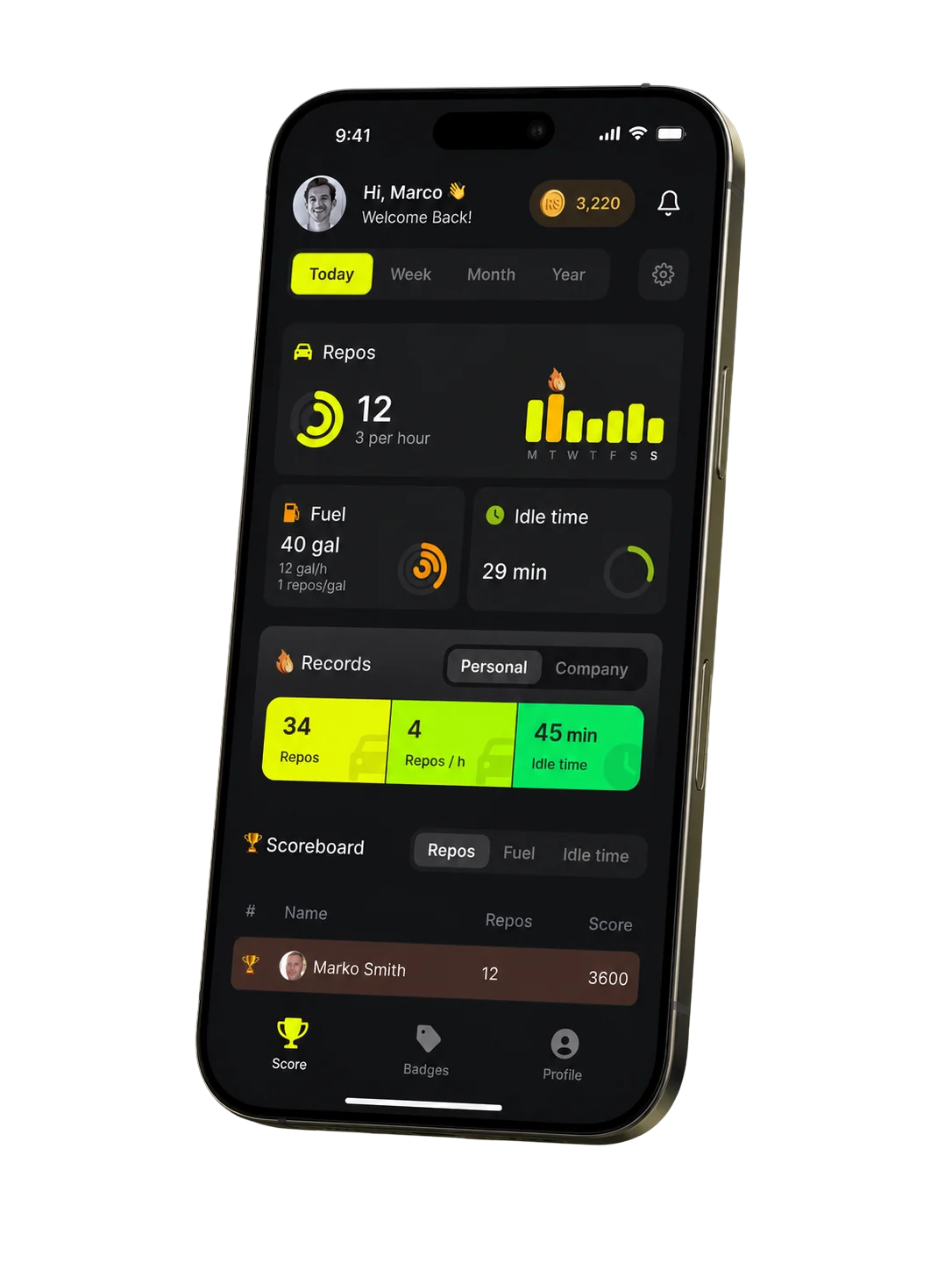
HNS Recovery runs one of the fastest-growing collateral recovery operations in Texas, with recovery, license-plate-recognition, and flatbed teams working around the clock across the Dallas–Fort Worth Metroplex and beyond. Every recovery, every mile, and every gallon of fuel was already being recorded — in three separate systems that never talked to each other.
Diffco built RepoScore to close that gap. The platform integrates with RDN (Recovery Database Network), Verizon Connect GPS, and Coast Pay fuel cards, correlates the data per agent, and delivers it two ways: a React Native mobile app that gives each agent a live view of their own results, goals, and ranking, and a web management portal that gives leadership team-wide visibility. Diffco also delivered the LPR (license plate recognition) component of the system as part of an additional AI discovery engagement. The product went from requirements to production rollout in roughly six months.

The challenge
Three systems. No single view of performance
The full picture was split across three platforms
Performance data at HNS Recovery lived in three places. RDN held every assignment and recovery. Verizon Connect held every vehicle's location, route, and idle time. Coast Pay held every fuel transaction.
Each system captured a slice of an agent's day; none of them showed the whole picture.
Performance is more than one number
For managers, that meant comparing reports from three vendors to answer a simple question — who is performing, who is slipping, and where. Spotting a trend or checking progress against a target required manual work every time.
For field agents, it meant no visibility at all: results surfaced at periodic reviews, long after the shift that produced them.
Turning signals into everyday insight
The company needed a single, trusted view that connected recoveries, driving efficiency, and fuel cost per agent, updated continuously, and readable in the cab of a truck between assignments.



Client goals
One performance system for every agent and manager
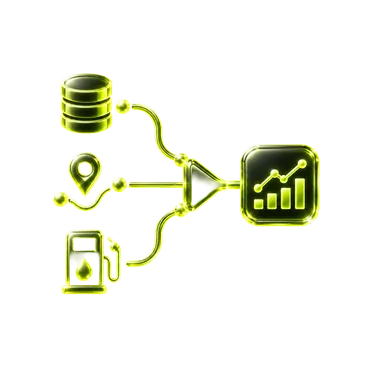
Unify three data sources into one performance model
Correlate RDN, Verizon Connect, and Coast Pay data per agent, per shift, automatically.
Give every agent a personal, real-time scorecard
Recoveries, fuel, and idle time — today, this week, this month, this year.
Put goals in context
Let agents set targets against benchmarks and see progress toward them.
Give managers team-wide visibility
Rankings, trends, territories, and early signals of declining performance without stitching reports together.
Make it stick in the field
A mobile experience fast enough for a 30-second check between recoveries, deployable to the whole team without friction.




Our contribution
From fragmented data to a production-ready performance platform
Diffco owned the product end to end: strategy, requirements, UX, mobile and web development, integrations, cloud infrastructure, and production rollout.
Understanding the real workflow
The team started with how performance data is actually generated at HNS — how an assignment moves through RDN, how a vehicle reports to Verizon Connect, how a fuel transaction posts in Coast Pay — and how managers and agents were using each system day to day.
Defining the performance model
Diffco documented the platform in a Product Requirements Document, then designed the information architecture that relates raw events to three core KPIs (repos, fuel, idle time), goals, benchmarks, rankings, and historical trends across four time horizons.
Building the management web portal
A Next.js admin console with agent management, map-based territory drawing and assignment, role-based access, sortable team and individual reporting with charts, and integration health monitoring.
Building the RepoScore mobile app (iOS and Android)
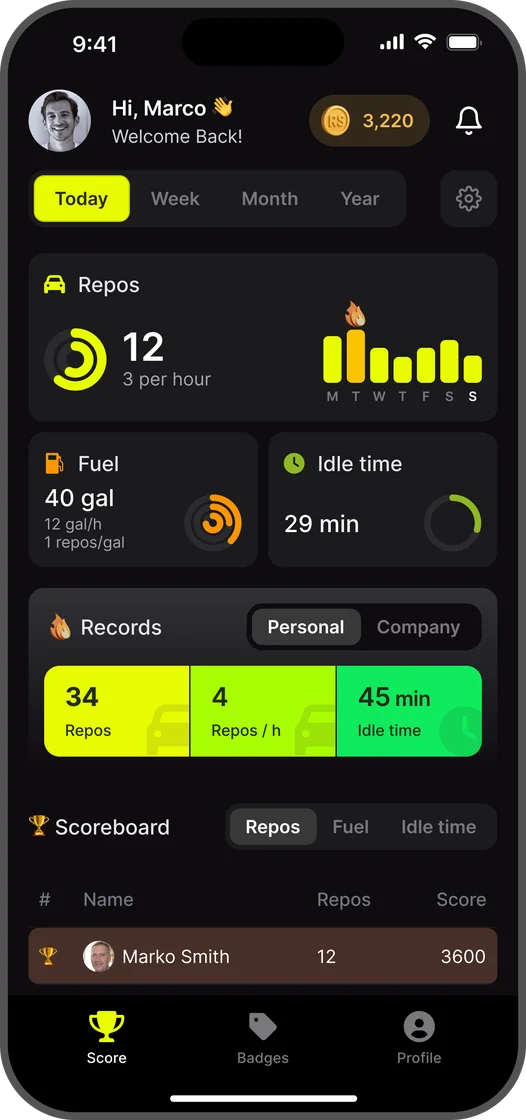
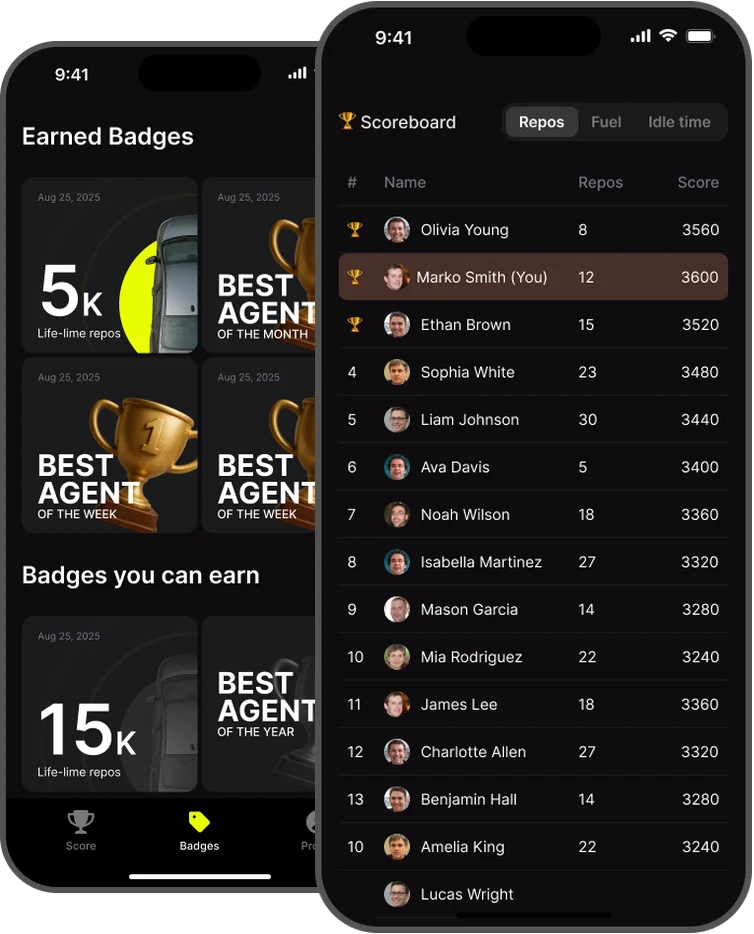
A React Native / Expo application with phone-number sign-in and SMS verification, a KPI dashboard with performance-state cards, Today/Week/Month/Year views, goal setting with benchmark comparison, a full leaderboard filterable by repos, fuel, and idle time, an alerts center, and an offline mode that shows last-synced data with a clear connectivity warning. Distributed to the team via direct install link and QR code for a same-day rollout.
Building the integration engine
A NestJS service polls Verizon Connect every 5 minutes for vehicle GPS, status, and driver assignments, and RDN and Coast Pay every 10 minutes for repossessed cases and fuel purchases. It detects driver-to-vehicle assignments automatically, links cases and transactions to agents, stores full history in PostgreSQL, and runs with leader election so multiple instances can poll safely. Fallbacks keep the metrics live when a vendor feed degrades — including a static-MPG mode used when a vendor's engine data stopped arriving.
Delivering the LPR and AI analytics layer
As part of an additional AI discovery engagement, Diffco delivered the license plate recognition part of the system for HNS's LPR fleet operations and defined the AI intelligence layer on top of it.
Designing the data experience
Complex operational metrics were translated into visual summaries an agent can read at a glance — not dashboards that need a training session.
Standing up the infrastructure
Terraform-managed AWS environment (VPC, ECS Fargate, ECR, load balancers) with GitHub Actions deploy pipelines, kept in a separate infrastructure repo so application releases and infrastructure changes stay independent.








AI intelligence
LPR and BI analytics
RepoScore's first job was to make existing data visible. The AI discovery engagement extended it into a system that reads the road and tells the business what to do next.
License plate intelligence
HNS's LPR fleet continuously captures plate number, timestamp, and GPS position for every scan. Diffco's LPR component ingests those hits — including through a lightweight middleware proxy for DRN camera data, hosted in HNS's own environment with adjustable filtering — matches camera kits and GPS trackers to specific vehicles, and enriches each plate with vehicle metadata: make, model, VIN where available, registration status, ZIP, city, and state. Scans from spotter cars and repo trucks can be filtered and compared by vehicle type, kit ID, or tracker ID.
Trail and heat-map visualization
Any vehicle's full route over a chosen window is rendered as a connected trail of GPS pings, while heat maps show scan intensity across the territory — where coverage is dense, where it is missing, and where zones are being over-scanned. Time-based filtering and historical playback (24 hours, 7 days, 30/90/180 days) let managers replay activity and spot patterns, with long-term history retained.
AI-powered insights and predictions
AI models analyze scan and recovery trends to forecast recovery hotspots and generate strategic recommendations for field operations: where to route LPR units, which zones are under-covered, and where the next recoveries are most likely.
Natural-language BI
A conversational interface lets a manager ask the system questions in plain English — “which zone had the most hits with no recoveries last week?” — and get answers drawn from live and historical data, with actionable suggestions attached. Role-specific KPI dashboards with configurable metrics and exportable reports sit alongside it, so the same data serves repossession operations, lender reporting, and management review.




Together with RepoScore's agent scorecards, this turns HNS's fleet data into a closed loop: the LPR layer tells the team where to look, the scorecards show how well they executed, and the analytics explain what to change.
Business impact
Turning operational data into measurable performance
One source of truth
Employees and managers now look at the same numbers, computed the same way, from the same three systems — ending the report-reconciliation work that used to precede every performance conversation.
Ownership shifts to the agent
Results that once arrived at a periodic review are now visible during the shift that produces them, with a personal goal and a team ranking alongside.
Cost visibility per agent
Fuel spend and idle time sit next to recovery counts, so efficiency is measured, not assumed — directly supporting the fast-recovery and high-volume performance HNS is recognized for by its lenders.
From reporting to recommendation
The AI layer moves HNS from looking at what happened to being told where to go next — recovery hotspot forecasts and coverage heat maps turn LPR scan data into routing decisions.
Results
From fragmented data to measurable performance
Tech stack
Mobile
React Native, Expo (Expo Router), TypeScript, Redux Toolkit, NativeWind
Web portal
Next.js, React, TypeScript, Tailwind CSS, Radix UI, TanStack Table, Recharts, Leaflet
Backend
NestJS (Node.js), TypeScript, Prisma ORM, PostgreSQL, Passport/JWT, Twilio SMS, Swagger
Integrations
RDN (Recovery Database Network) API, Verizon Connect GPS API, Coast Pay fuel transaction API, LPR camera data (DRN middleware proxy)
AI & analytics
LLM-based natural-language query interface, predictive analytics engine for recovery hotspot forecasting, geospatial trail and heat-map visualization, configurable KPI dashboards
Infrastructure
AWS (ECS Fargate, ECR, ALB, VPC, S3, SES), Terraform, GitHub Actions CI/CD
Security
Role-based access control, phone/SMS authentication, encrypted data in transit and at rest, audit logging